Prayer of the Outsiders
Anonymous Artists from Karachop
Anastasia Akhvlediani
Mari Babaevi
Jia Jia Chen
Tamar Gurgenidze
Qeu Meparishvili
May 18-23, 2026
Exhibition visiting hours:
May 18-22, 12-8pm
May 23: 12-5pm
Opening May 18, 6-9pm
Location: Peace Cathedral, Evangelical – Baptist Church of Georgia, Spiridon Kedia Street 6, Tbilisi, Georgia
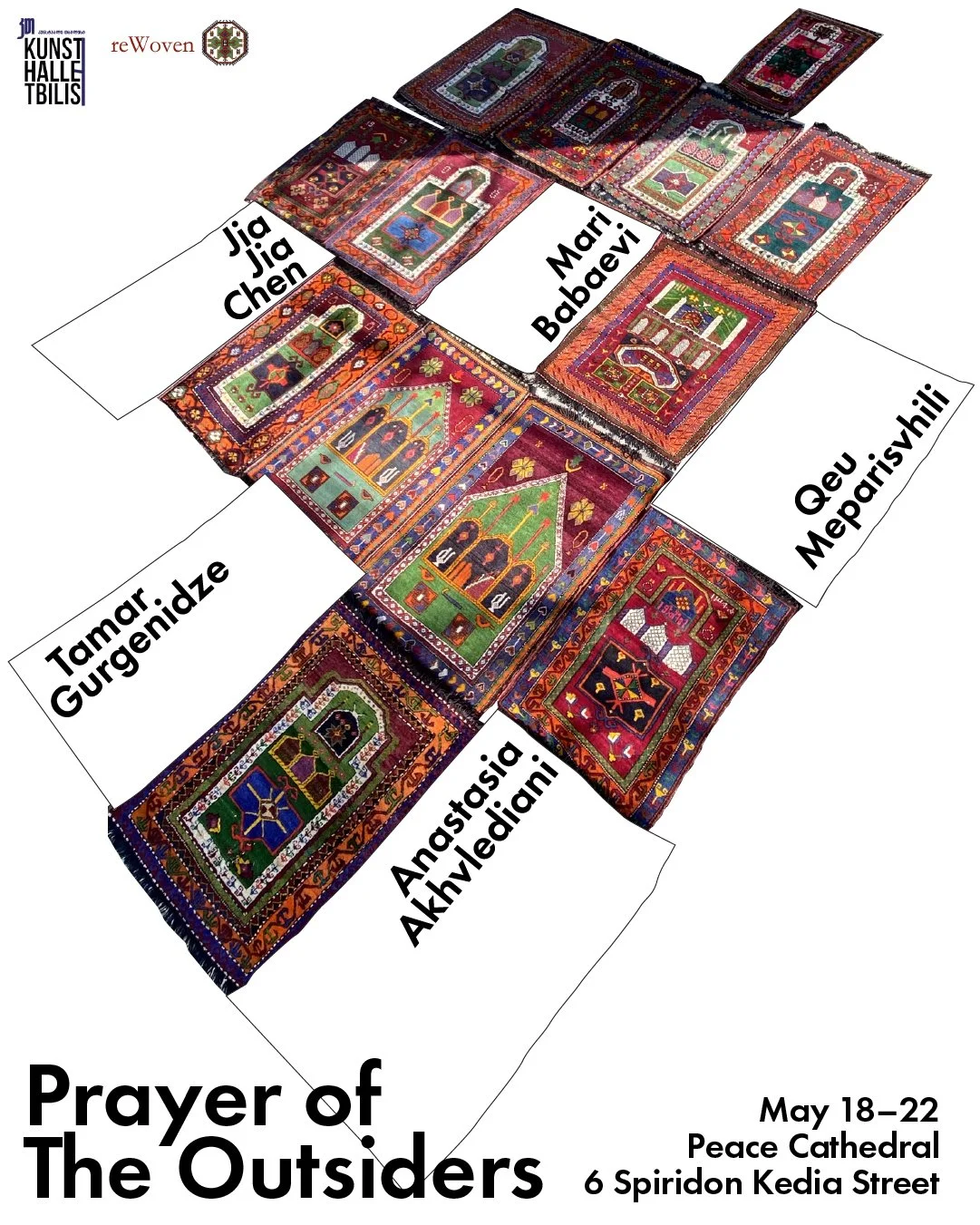
Kunsthalle Tbilisi in collaboration with reWoven presents Prayer of the Outsiders, an exhibition held in parallel to Tbilisi Art Fair (May 21-24, 2026) curated by Irena Popiashvili. The exhibition is held at the Tbilisi Peace Cathedral - a unique venue housing a church, mosque, and synagogue under one roof. A programme of events accompanies the exhibition.
The exhibition centres around historic prayer rugs from the old mosque in the village of Lambalo, part of the major Azerbaijani settlement of Karachop/Iormughanlo. In 2021, its floor was entirely covered with prayer rugs woven by anonymous women artisans as dedications, dating from the 1950-90s. Returning to the mosque in 2023, the rugs had vanished, replaced by imported, machine-made carpet. The reWoven team set out to recover the rugs and, with the permission of Lambalo’s imam, restored the surviving 20, perhaps half the original number.
The Lambalo rugs represent a testament to an unknown period in the weaving tradition of the South Caucasus. A fusion of traditional and 20th century contexts, they are religious objects made within the atheist Soviet Union; handwoven in an era dominated by factory-made goods. Both Islamic and Soviet, Georgian and Turkic, they emerge from a unique cultural context and are in themselves important textile artworks.
Highlighting the artistic, cultural, and devotional traditions of the region, these prayer rugs are displayed in both the nave of the Peace Cathedral and the Peace Mosque, alongside works by young artists: Anastasia Akhvlediani, Mari Babaevi, Jia Jia Chen, Tamar Gurgenidze and Qeu Meparishvili.
Anastasia Akhvlediani’s three dimensional work “Where did Pirosmani see a Giraffe?” directly engages with the shifting nature of visual memory, examining how memory alters itself through layers of interpretation and repetition. Her piece traces a path of exploration through the pre-existing, but changing landscapes of memory, whether visual or purely ephemeral. Anastasia Akhvlediani is completing her Master of Fine Arts at the Munich Academy of Arts.
Similarly exploring themes of cultural displacement, Mari Babaevi addresses questions of identity through her textile artworks, based on her experience growing up as an Azerbaijani living in Georgia. Her series “Carrying Home,” included in the exhibition, reflects on changing environments and the act of carrying home into public space. For Babaevi, ornament becomes a sign; home is no longer a place but a code the artist carries. In her process, ornament is cut and reassembled, like a body adapting to a new environment. Suggesting that home becomes a process rather than a fixed form. Mari Babaevi is currently studying Fashion Design at Polimoda Firenze (2025–2029), Italy.
Working across different materials, Qeu Meparishvili creates clay sculptures and installations known for their experimental approach with various materials and expressive forms. Her practice often explores mythology, human nature and legends, connecting personal and socially significant issues. In this exhibition, her steel and aluminium sculptures “Healer” and “Togetherness” merge the ancient technique of Georgian icon painting - with its rich national symbolism and ornamentation - with themes of contemporary life.
Also engaging with place and material memory, Jia Jia Chen, a ceramic artist and designer based in Tbilisi, brings her cross-cultural experience to the exhibition. Born in China and raised in Australia, her practice explores the translation of cultural forms through ceramics, engaging material histories, place, and the sensory and narrative capacities of objects. The clay pieces she presents in the exhibition are moulds of architectural details of buildings and places in and around Tbilisi, creating a tactile archive of the city’s physical memory.
Tamuna Gurgenidze works as a multimedia artist across ceramics, painting and 3D video art. Her ceramic sculptures introduce an element of surprise through works such as ‘Pregnant Women With Mobile Phone’ and ‘Bless Your Souls Beautiful Girls.’ These vibrant glazed ceramics are deliberately larger than traditional porcelain statues and fundamentally subvert the conventional themes of decorative porcelain. Rather than featuring the expected cute ballerinas or charming animal statues, Gurgenidze’s work presents contemporary subjects that challenge our preconceptions on ceramic art and its traditional decorative role.
This deliberate contradiction is similar to the free spirited approach found in the historic Lambalo prayer rugs. The anonymous women authors of these rugs worked much like contemporary artists – they did not follow canonical prayer rug designs but instead created their own versions, adapting traditional forms to their creative vision. Just as these unknown weavers reimagined Islamic prayer rug traditions within the Soviet Georgian context, these contemporary artists are transforming the traditional themes and mediums to their own bold artistic statement.
Events Programme
18 May – Opening event with live musical performance by Qaraçöp Ansambılı curated by Einar Eidarov (Subsequence)
20 May – Traditional and contemporary musical performance by Ashiq Nargile and Ben Wheeler
Guided tours of the exhibition are available by appointment throughout the opening period.
For further information and images please contact
Cosima Stewart +995595006840